Eat Clean
Ultra Processed Food Analyser


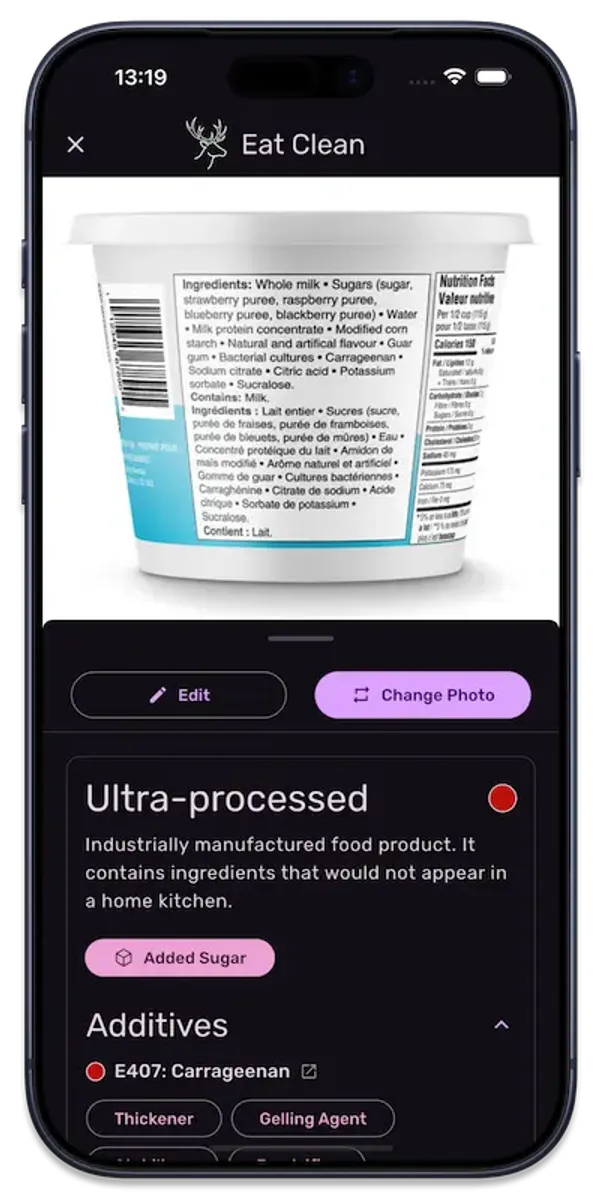
The leading processing classification system is NOVA. The NOVA classification splits food into 4 groups: unprocessed, culinary ingredients, processed food and ultra-processed food.
Unprocessed is food that comes from nature, the edible parts of plants and animals.
Minimally processed food have some minor processing but have no ingredients added. This processing includes drying, roasting, grinding, pasteurising and freezing. These increase shelf life but do not change the food significantly.
These are ingredients used to help cook and season food. They are often made from unprocessed food. These include oils produced through crushing seeds nuts or fruits (such as olive oil), salt, sugar, vinegar, starches, honey, syrups extracted from trees and butter.
Relatively simple foods made with unprocessed food and culinary ingredients. These are foods you could make yourself in your kitchen such as bread, cakes, pastries and biscuits.
Industrially manufactured food products made up of several ingredients including sugar, oils, fats, salt and food substances of no or rare culinary use.
They often make use of industrial techniques such as extrusion, moulding and pre-frying or have additives made of synthetic materials. This processing is to make the final product palatable or profitable by disguising low quality ingredients.
You can tell a food is ultra processed when it’s ingredients list includes varieties of sugars (fructose, corn syrup, fruit juice concentrates, invert sugar, maltodextrin, dextrose and lactose), modified starches, modified oils or additives to enhance the appearance of the food.
UPFs are increasingly being linked to a variety of different health problems. A recent study found that consuming lots of UPF puts you at greater risk of dying early.
Ultra-processed food has been linked to 32 different health conditions, including: - Obesity - Type 2 diabetes - Cardiometabolic diseases - Cancer - Gastrointestinal disorders - Asthma - Anxiety - Depression - Heart problems
A particular health concern is meat that has been ultra processed. Meat that has been transformed through salting, curing, fermentation, smoking, or other processes to enhance flavour or improve preservation has been linked to colorectal cancer. WHO has classified ultra processed meat as a class 1 carcinogen, the same as tobacco smoking and asbestos.
There is a range of hypotheses around why UPF has such negative impacts on health. These include:
* Higher palatability * Higher energy density * Promotion of a faster eating rate – for example, due to softer texture or other changes in the food structure or matrix * Differences in the nutrient content – such as higher saturated fat, salt and free sugars content alongside lower fibre content * Effects of high temperature in the production of processed foods * Effects of specific additives, including low or no calorie sweeteners * Contaminants from packaging * Higher consumption due to widespread marketing and lower cost of processed foods * Combined effects of the above
Manufacturers add colours to products for a variety of reasons. Often the aim is to make the food more attractive, appealing or appetising. The colour of food can influence what you think it tastes like. Bright colours can be used to add a sense of fun in otherwise colourless food.
Brightly coloured food makes you think it is fresh. Adding colours can offset colour loss that can happen when the food is exposed to light, air or extreme temperatures used in industrial processing. Controlling the colour of the product also helps ensure the end product always looks the same, preventing natural variations in colour from being seen by the consumer.
Food has a length of time before it becomes inedible. Historically this time was extended with the use of oils, salts drying and smoking methods.
Modern preservation methods involve the use of different chemical compounds that inhibit the growth of bacteria. This allows manufactured products to be transported further and last longer on supermarket shelves.
Most food is spoiled by contact with the air. This is known as oxidisation. This happens quickly in food with high fat content, which turn rancid when exposed to oxygen. Antioxidants are added to food to prevent or inhibit the oxidation process.
Also known as PH regulators. These are added to food as a form of preservative. Food being more acidic can help prevent bacterial growth, allowing it to be safely eaten for longer. In some foods the increased acidity can also improve the flavour.
Also known as thickening agents. Thickeners are substances that are added to increase the viscosity of a liquid without altering the taste. This can improve the way a food feels when it is in your mouth.
Substances added to food to help preserve its structure. This could be anything from preventing ice crystals from forming in ice-cream to preventing the oil and water from separating in salad dressing. This helps ultra-processed food to maintain consistency.
These are additives that prevent trace minerals (copper, iron, calcium) from reacting with the rest of the food. This helps preserve food by preventing oxidation.
They can also be used to help preserve colours in canned vegetables, keeping them looking vibrant.
Naturally oil and water do not mix. Oil will usually separate and float on the top. Emulsifiers are used to prevent this from happening and keep the oil and water separating for months or even years.
The use of emulsifiers is prevalent in ultra-processed bread as they create squishiness and a soft feeling long after the bread should have become hard.
The purpose of a raising agent is to add air into the food. This creates food that is light and fluffy. It can also have the benefit of increasing the surface area for salt and flavourings to hit your tongue.
Many kinds of food become soft when exposed to pressure, air, water heat or over time. Firming agents are added to give foods a solid feeling or even a nice snap when you bite into them.
Minerals like salt that come in a powder often clump together into lumps when exposed to moisture. To prevent this additives are used to prevent the formation of lumps.
Or taste enhancers themselves do not have flavours. But when added to food they intensify the flavours that are already there.
Over time the water in food is gradually lost and it becomes dry. To prevent this humectants are added. These hold the water in place, allowing the food to stay moist for longer. This allows products to sit on shelves in stores for many months and still feel soft or chewy when you bite into them.
Antibiotics are no longer used in food for humans. In the 20th century they were sometimes used for food preservation.
Gelling agents are added to transform a liquid into a solid or gel. This can create the wobble in a jelly, keep a jam from leaking out of a donut or set a yoghurt.
This has a lot of benefits to creating hyper palatable ultra-processed foods. It can be used to replace fat when creating low fat foods. It can give creamy feeling to otherwise watery foods. They can even be used to create different textures when you bite into food, a soft melting feeling or even chewy.
Glazing agents are typically waxes, resins or oils. They are used to create a waxed glossy look. Another benefit as water cannot pass through the glaze, preventing moisture from getting into and rotting the food and stopping water from escaping and making it dry.
The inside of air-tight packaging can be controlled by manufacturers. Specific gasses or mixtures of gasses can be included with food to prevent oxidation, stop mould from growing, provide a protective cushion or even protect the bright fresh colours.
Sugar hitting your taste buds sends please signals to your brain encouraging you to eat more. Sweeteners are additives that achieve this but without the calories in sugar. This is essential in creating zero sugar products, but maintaining the addictive qualities of the sugar filled version.
In the production of ultra-processed foods, large-scale stirring, heating, and pumping can cause liquids to froth and create unwanted bubbles. Anti-foaming agents are added to prevent this foam from forming or to break it down quickly.
In a factory setting, foam is a major problem as it can clog machinery, cause vats to overflow, and interfere with accurate weight measurements. These agents ensure that products like fruit juices, soft drinks, and deep-frying oils remain stable during high-speed manufacturing. They also allow for a more efficient filling process, ensuring that when you buy a carton of juice or a bottle of soda, it is filled with liquid rather than air bubbles.
Also known as flour treatment agents. These are added to flour or dough to improve baking quality and consistency. In industrial bread making, they are used to strengthen the dough so it can withstand high-speed machine handling without tearing.
They can also be used to bleach flour to make it appear whiter or to speed up the proving process of the dough. This allows manufacturers to produce massive quantities of bread and pastries in a fraction of the time it would take using traditional methods, ensuring every loaf has the same uniform height, colour, and texture.
Compressed gasses are used to provide the pressure needed to make food spray out of an airtight container.
Artificial flavours can be overwhelmingly strong, making them potentially unpleasant to eat. Flavour solvents are used to dilute the chemical flavours and spread them evenly through a product. This means every bite ends up with a consistent amount of flavour.
Also known as bleaching agents or flour treatment agents. These are chemicals used to artificially whiten flour or other food products during industrial processing. In its natural state, freshly milled flour has a yellowish tint. Bleaching strips this colour away to create the bright, stark white appearance expected in supermarket bread and pastries.
Beyond just the look, bleaching agents alter the structure of the proteins in the flour, making the dough less sticky and easier for high-speed factory machinery to handle. This process bypasses the traditional "aging" method, where flour is left to whiten naturally over several weeks. In ultra-processed foods, these agents allow for a faster, cheaper production cycle while ensuring the end product looks consistently "pure" and uniform.
Also known as colour stabilisers or fixatives. These are substances added to food to preserve its existing natural colour or to prevent it from fading or turning an unappealing shade during industrial processing. This is used to keep a product looking vibrant and fresh.